 Despite the lingering chill here in the Rocky Mountains, we’re collectively hoping that spring will emerge soon. With that in mind, Coach Stacy has been busy with a dizzying array of home improvements – painting, plumbing, electrical work, and carpeting – a spring-cleaning project on steroids.
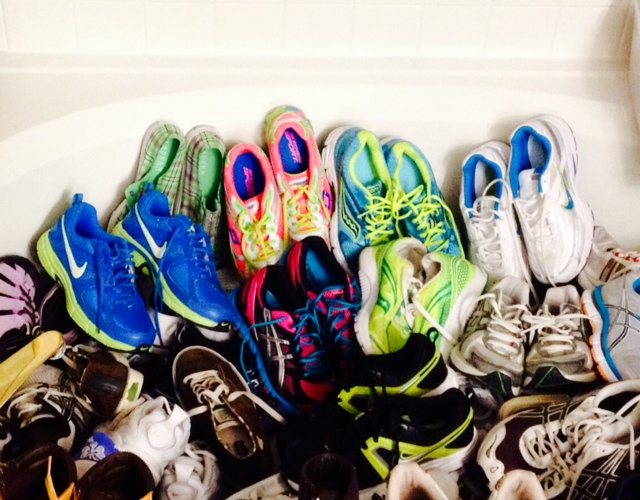
I was summoned to the Coach Stacy Cabana a couple of weeks ago to check out the new carpet – which was quite lovely – when I happened to notice the master bathtub filled to the rim with athletic shoes.
“So…um…what’s with the shoes?” I inquired.
“Temporary storage,” Coach said. “I had to get them out of the closet so the installers could lay the carpet in there.”
“You mean all of those tennies were in your closet? Why, there must be dozens…”
Coach turned to face me and responded with unqualified conviction, “You can never have too many pairs of sneakers.”
I knew better than to argue. But my curiosity was peaked, so I started counting. 1, 2, 3, 4….
As I counted, Coach Stacy regaled me with the myriad reasons why one might be compelled to own multiple pairs of athletic shoes.
First of all, there’s the crazy complexity of the human foot: 26 bones, 33 joints, 107 ligaments, and 19 muscles. Such intricate anatomy requires just the right shoe for the demands of each specific activity. Running shoes are for running. Hiking shoes are for hiking. And neither work well on the golf course or Zumba class.
10, 11, 12…
Variety in athletic footwear also helps to ward off foot injuries. Different shoes naturally distribute the impact of movement differently, which subsequently reduces the strain, wear and tear on the tissues, muscles, bones and joints of the feet, thus lessening the risk of overuse injury. And of course, alternating shoes tends to extend the lifespan of each pair. The average running shoe, for example, is good for 350-400 miles. Say you run 4-5 miles a day, three days per week – that pair of shoes won’t last a year, especially if you throw a 10K or half marathon in from time to time. But if you alternate your runs with two pairs of shoes, you’ll double the mileage of each pair.
18, 19, 20…
Related to this is the fact that the average foot has 125,000 sweat glands, which, believe it or not, are capable of excreting nearly a quarter of a pint of moisture in the course of a day. Unless shoes are given the opportunity to dry out thoroughly between uses, that moisture turns into a thriving mass of bacteria which causes shoes to fall apart more quickly as well as contribute to the onslaught of athlete’s foot.
25, 26, 27…
Fashion also plays a part in Coach Stacy’s infatuation with athletic shoes. “Just the right shoe to match the outfit.” Recently, while shopping with Coach in the shoe department at Macy’s, I made the mistake of commenting that she already had a pair of blue sneakers, which led to a dramatic sigh and a pronounced rolling of the eyeballs as she responded disdainfully, “Those are navy blue. I need turquoise blue to match my new warm up. You know, the one with the silver trim?”
I took her word for it.
37, 38, 39…
Speaking of shoe shopping, do you know your foot type? Are you flat-footed or high arched? Do you tend to over pronate or under pronate? If you don’t know, try taking the wet test: Step your wet foot onto a paper bag and assess your foot type based on the shape that you see.
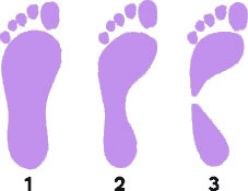
A Flat Arch – Your footprint shows the entire sole with very little curve. This foot type causes regularly recurring foot injuries such as plantar fasciitis and IT band syndrome. Go for a shoe with maximum stability and motion control.
A Neutral Arch – Your footprint is “C” shaped, with only the slightest over pronation. You probably don’t have many problems with your feet outside of occasional bouts with shin splints or plantar fasciitis. Opt for a mild-stability shoe to prevent the arch from collapsing.
A High Arch – You tend to under pronate (or supinate), which means you land on the outside of your feet when you walk. This tends to result in achy joints caused from too much pressure traveling up your legs. If this is your foot type, you should opt for a neutral cushioned shoe with a soft midsole.
42, 43, 44, 45
Here are a few more of Coach Stacy’s tips for buying the right shoes for happy feet:
- Bring or wear athletic socks with you when you go shopping for tennies. And while you’re at it, bring your orthotics as well. Wearing these while trying shoes on will ensure a proper fit.
- Avoid buying shoes that are too short. Use the “rule of thumb” – the end of your longest toe should be a thumb’s width away from the end of the shoe. While shoes tend to stretch out with wear, they don’t tend to stretch in length and buying shoes that are too short can cause hammertoe.
- Go shoe shopping later in the day. Research has shown that our feet tend to expand or swell somewhat as the day progresses, so shopping later in the day may prevent you from purchasing shoes that are too small.
- Avoid buying shoes simply because they’re a) cute, or b) on sale. Comfort and fit are far more important than looks or price.
55, 56, 57…58
Turns out Coach Stacy is the Khloe Kardashian of the athletic shoe world; there’s a pair of tennies in her closet for every sport imaginable. And while 58 pairs of sneakers may seem a little over the top, I’ll probably never be able to tell Coach that her shoes don’t match her warm-up. On the other hand, such a comment would provide her with a compelling reason to go shoe shopping, which she probably wouldn’t mind at all.

 COACH STACY'S HEALTHY U

Hilarious and true about Coach Stacy’s shoe collection!
Even though I’m a “run bunny”, it’s all about matchy matchy! Haha! Love the article!
The article was very funny and informative at the same time