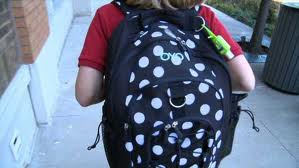
 I was tending to my lawn early one morning last week when I spied a young man trudging down the opposite side of the street, headed toward the nearby high school, a bulging and enormous backpack strapped to his shoulders. He paused briefly waiting for a car to pass in order to cross the street, and in that fleeting and perilous moment, he leaned back slightly and I was certain he was going to tip over backwards from the weight of his load. He quickly recovered and continued on his way, shoulders hunched and obviously straining under his cumbersome pack, which was roughly the size of a small suitcase.
“Everything but the kitchen sink,” I thought; back problems in the making.
Where backpacks are concerned you’ll want to exercise some caution. Recent studies have shown that heavy or improperly carried backpacks can lead to back pain and poor posture, as well as curvature of the spine, spinal compression, pressure on neck and shoulder blood vessels and nerves, and Spondylolysis (lower back stress fractures). An astounding 7,000 emergency room visits due to backpack injuries are reported every year. 58% of orthopedists have treated patients complaining of back and shoulder pain related to backpacks. Clearly, “backpack bulge” is a problem.
It’s widely believed that increasingly more rigorous academics are requiring students to carry as much as 40% of their body weight in their backpacks. As a general rule of thumb, a backpack should weigh no more than 10-15% of an individual’s body weight. For example, 75 pound child’s backpack should never weigh more than 7 ½-11 pounds. If you weigh 120 pounds, your pack should top off at 12-18 pounds. However, a recent survey of the American Physical Therapy Association found that more the 50% of children reported carrying backpacks that are too heavy.
In the future, as eReaders and eBooks become more prevalent, we might see the physical problems associated with heavy backpacks diminish a bit. Meanwhile, here are additional tips for packing and carrying backpacks safely:
- Pack heavier items first so that they are closest to the body.
- The backpack should not hang more than 4 inches below the waistline. Adjust the straps accordingly.
- When lifting the pack, bend at both knees and lift with the legs.
- Use a backpack with wide, heavily padded shoulder straps and a lumbar cushion. The straps should hug the center of the back.
- Always wear both straps so that the weight is distributed evenly.
- If heavy loads are routine and it’s feasible, you might try going with a wheeled backpack.
- Look for functional features like pockets and compartments to help spread the weight out.
- Attach a luggage tag to the pack with an adult’s contact information so that if it’s misplaced, it might find its way back to you.
And last, but not least, pack only the items you’ll need any particular day. Extra and unnecessary items only add weight. You can leave the kitchen sink at home.

 COACH STACY'S HEALTHY U