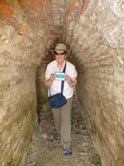
Phyllis with a find in Myanmar
Did you ever play pirates where you were a kid? Painstakingly burying a “treasure” – perhaps your little brother’s Tonka truck or your big sister’s bangles. Then creating an elaborate map, leading a would-be treasure hunter – your little brother or big sister – ten paces here, five frog-leaps there, to where the “X” marked the spot where the treasure was buried. Exciting fun, playing pirates.
You can reclaim that fun through geocaching, a relatively new outdoor pursuit, which is part scavenger hunt, part orienteering. One of our good friends, Phyllis McGuire, is an avid geocacher, which she describes as high-tech treasure hunting. Instead of a map, she uses GPS (Global Positioning System). And instead of a treasure, she hunts for “caches,” or hidden containers filled with trinkets and mementos.
After a recent workout class, Phyllis allowed us to tag along for a short geocaching expedition during which she filled us in on the game’s basics:
- “Geo” stands for geography and “cache” stands for hidden provisions or valuables.
- To find caches, participants use GPS-enabled devices to navigate to a set of coordinates where such containers are hidden. Phyllis used to use a GPS receiver but now, more often than not, she simply uses the GPS app on her iPhone.
- Geocaching is an ideal outdoor pursuit in and of itself for adventure-seekers. However, many like to pair geocaching with other outdoor pastimes such as hiking, canoeing, camping, mountain biking or rock climbing.
- To get started in geocaching, go to www.geocaching.com and register for an account. Membership is free, requiring only one’s name, address and a geocaching handle. Once you’re registered, you can consult the website for caches in particular areas, then load the coordinates into your GPS device and start hunting.
- Caches vary widely in terms of size and contents. A “micro” cache is generally less than 100 ml, such as a film canister. “Small” caches are about the size of a sandwich, and “regular” caches are shoebox sized. “Large” caches are the size of a bucket or larger.
- The primary requirement for a cache is that it contain a logbook or log sheet of some sort. Once a geocache is found, players sign the logbook and return the cache to its original location.
- Geocaches can also contain items for trade, the possibilities of which are endless and include baseball cards, small toys such as troll dolls, stickers, polished stones, batteries, hand and foot warmers, collector items, whistles, matches, Lego pieces, playing cards, maps, silver dollars or small tools. Geocaching etiquette stipulates that if an item is taken from a cache for trade, something of equal or greater value must be left in exchange.
- There are also certain items that should never be included in a geocache, such as weapons or explosives, drugs or alcohol, food, or heavily scented items.
- Caches are hidden on every continent, thus geocaching is an enjoyable pursuit for world travelers like our friend Phyllis. Caches can be found in utterly easy terrain such as the super market parking lot or far more challenging environments such as the top of a 10,000-foot peak or underwater.
- Geocaching is a hobby that requires very little in the way of equipment or supplies, aside from a GPS device. Depending on the location or terrain, you might consider packing food and water, bug spray, sunglasses and sunscreen, extra batteries, maps and a compass, a pen or pencil, a hat and work gloves, flashlight, extra clothing, a signal mirror and whistle, and matches.
The result of our first geocaching expedition was somewhat less successful than we’d hoped. Coach Stacy is a bit of a chatterbox, and while holding forth, she tends to be rather unobservant with regard to her surroundings (although she’ll tell you she was focused more on avoiding snakes than locating the cache). I, on the other hand, was evidently born with no discernable sense of direction. So together, we failed to locate the cache, leaving poor Phyllis to only speculate as to the relative wisdom of going geocaching with two ditzy blondes. Turns out, she returned to the coordinates some days later and found the micro cache, a film canister covered with camouflage duct tape and containing only a rolled up log sheet.
“Anyone could have missed it,” she said in a misguided attempt at consolation. But it’s more likely that our geocaching handles should be “Ditzy Blonde 1” and “Ditzy Blonde 2.” And besides, Coach Stacy is quite a bit more accomplished at locating athletic shoes on clearance at the local shoe warehouse.
Still, we’ve noticed that Phyllis hasn’t invited us back for another geocaching expedition…
For more information on geocaching, check out the following resources:
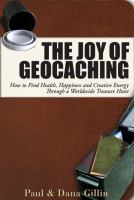 The Joy of Geocaching by Paul and Dana Gillen
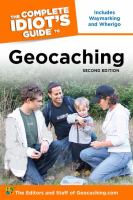 The Complete Idiot’s Guide to Geocaching by the editors and staff of Geocaching.com.

 COACH STACY'S HEALTHY U
Well now I know where my bangles went…. : )
…um, yeah, I’ve been meaning to tell you…