Kudos to Aniston for bringing sexy back to the over-40 crowd. She’s set the fitness bar firmly higher for all of us. Read how Yogalosophy made the actress “stripper-ready.”
Kudos to Aniston for bringing sexy back to the over-40 crowd. She’s set the fitness bar firmly higher for all of us. Read how Yogalosophy made the actress “stripper-ready.”
 When I was a Texas undergrad, I was consistently attracted to the cowboys who wandered about campus; years in the saddle made them look mighty fine from behind in their Wranglers. Of course, the butt muscles are the largest muscles in the body. So when worked out, they look terrific. But ignored, they present a LARGE problem in a hurry. Three muscles known as the gluteus maximus, the gluteus medius, and the gluteus miniumus, make up one’s rear end. The maximus comprises the biggest portion of the tush, the medius sits at the top of the hips, and the minimus rests in between.
Most of us are motivated to work our glutes in order to look toned and sculpted and fabulous in jeans. However, a strong butt serves functional purposes as well. Not only does it help stabilize the back, it also helps us climb stairs, sit and stand, get in and out of the car, and carry out daily chores and countless other tasks. The following five exercises will activate the gluteal muscles and transform droopy and flabby into shapely and firm for a sexy and strong derriere:
Glute Bridge – Double or Single Leg
Platypus Walk
This is a simple move that works the butt and can be done anywhere, anytime with no equipment. The platypus walk engages the butt, thighs, and core, and challenges one’s balance as well. I love this move for all the different muscles it involves and it’s also fun to do.
Bodyweight Squat
Ready: No equipment is needed as you start with feet shoulder width and toes lined up with your knees. Place your hands on the side of your hips. Stand tall with your chin parallel to the floor, shoulder blades together, abdominals engaged and chest up. Inhale and exhale throughout the movement.
Set: Keep your weight shifted back onto your heels as 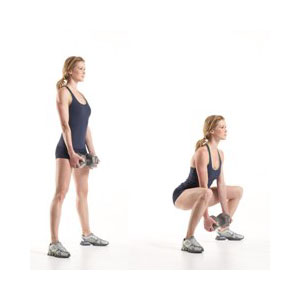 your hips and butt prepare to jut out behind you. A good cue is to think of sitting in a chair. Like a hinge, your hips and knees bend in unison as you lower your butt, and your knees will start to shift forward.
Go: Begin to slowly lower yourself into a “sitting in the air” position with arms extended forward for balance. As you squat, try not to let your knees pass over your toes and keep your heels planted flat on the floor. Align knees with hips throughout the movement. To engage the glutes muscles push through the heels more as you begin the upward movement. Repeat 5-20 times.
Exercise Challenge: Add weight in your hands and maintain the above position.
Bicycling
 Bicycling is an outstanding butt workout, as it engages multiple muscles, including the glutes and burns about 500 calories per hour. To avoid back or knee strain, distribute your weight evenly and don’t slump. Keep your shoulders back and your hands even with your shoulders on the handlebars. Adjust your seat so that your knees stop just short of locking when you push down on the pedals. Adjust your gears so that the ride is challenging, but not impossible – and be sure to wear a helmet for safety.
Standing Gate Openers
Ready: Stand tall with your feet shoulder width apart, toes facing forward, chest up and arms by your side. If needed, use the wall or a chair for balance.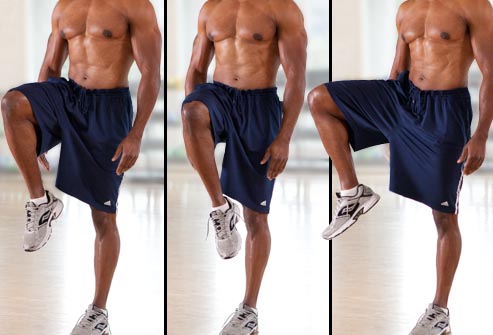
Set: Think of a gate that opens and closes like a hinge as your prepare to lift one leg up and off the floor.
Go: As you begin the move, engage your abdominals and shift your weight to one leg as you lift your other knee up towards your chest. Keeping your knee in a 90-degree bent position, rotate the bent leg across your body and back as if it is a gate opening and closing. Try to keep your other leg and hip stable as you repeat the move 5-10 times.
 Whenever I take on a new client for personal training, I ask one key question: “What part of your body do you want to change the most?”
A frequent response is, “I hate my thighs.” In fact, a client I trained many years ago in Beverly Hills once said that while most people carry the weight of the world on their shoulders, she carried it on her thighs. It evidently never occurred to her that her nightly indulgences in wine, cheese and chocolate had something to do with her prominent saddlebags.
So let’s examine this pesky trouble spot. The technical name for the front of the thigh is quadriceps. “Quad” means four – thus, there are four main muscles in the thigh:
Strong, sculpted thighs not only make your chores easier but also make your clothes fit nicely. The main reason my clients want to work their thighs is to improve their appearances – to look good in shorts and swimsuits. But my goal in working their thighs is to help make them stronger overall. Here are some of my favorite thigh exercises that I teach clients. Please note that if you have any knee problems you may need to modify these to avoid injury.
Sumo Rotational Squat – Think of the Sumo Wrestler stance and you get the picture. You start by standing with your feet spread far apart outside your hips. From there you squat down Sumo-style. Hold and rotate on one leg 180°; hold and rotate back. Repeat 5-10 times and then switch to the opposite leg. For a more advanced move hold a medicine ball during the exercise.
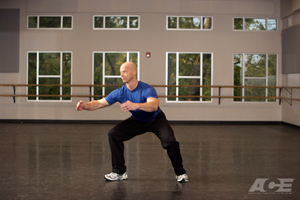
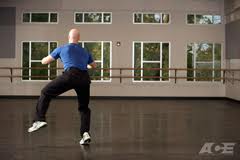
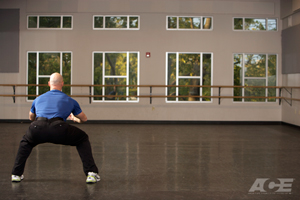
Sumo Squat with a Medicine Ball or Dumbell – Same Sumo stance as above without rotating. Hold a medicine ball or dumbbell, then Sumo squat up and down for at least 10 reps.

The Squat – A classic move that never gets old, and highly functional too, as it’s replicated constantly in daily activities. Think of the movement getting in and out of a chair and there you have the Squat. Many of us tend to plop in our chairs and that’s one reason our quads get out of shape. Stop the plopping – work those quads. Use the Squat as a refreshing re-boot when your brain starts to lag in the middle of the afternoon at work. Use your office chair, but make sure the rollers are locked or that the chair is stabilized against a wall so that it doesn’t roll away. You can also modify this exercise, squatting against a wall.


Lunge – Another classic exercise that never goes out of style. Lunges can be modified to fit your level of fitness. The deeper the dip, the greater the burn. If you have bad knees, decrease the dip.

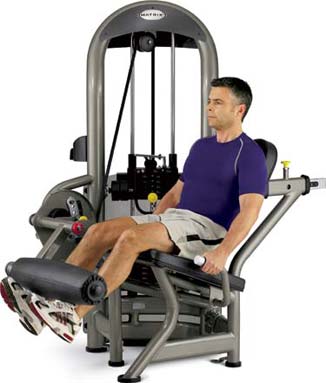
Leg Extension – Use the leg extension machine at your gym for 2-3 sets of seated leg extensions. Or, if you have bad knees, use a chair and add a band for resistance. But if you want a boot camp move, add Russian kicks to your workout. Move over, Mikhail Baryshnikov.
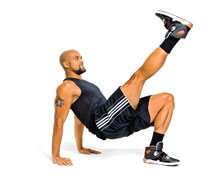
Side Plank Thigh Burner – Lie on your side with your elbow on a mat. Bend the bottom knee and lift the other straight leg up and down. Repeat 10-20 times then switch sides.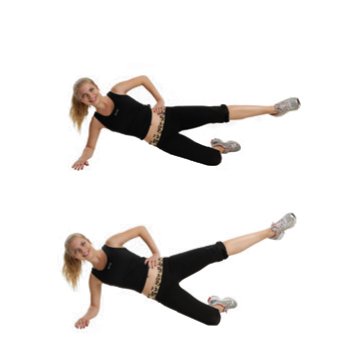
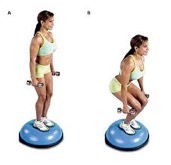
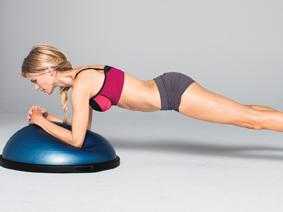
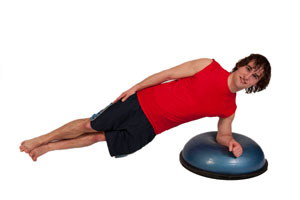
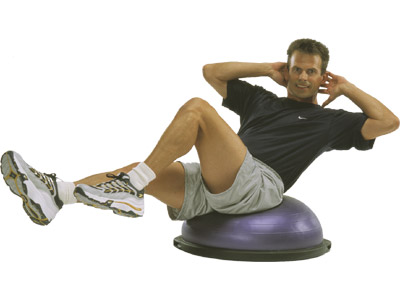
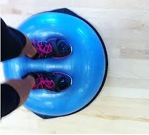 Heaven forbid, but if my fitness studio were ever on fire, the one piece of equipment that I’d run in and save would be my BOSU. Funny named and funny looking, that bright blue half ball, half stair-stepper. The BOSU hit the market in the year 2000 and quickly became a fitness staple in fitness centers and home gyms across the country, and well worth its $100 price tag for the fact that all major muscle groups can be worked using the BOSU.
What I love about this handy little piece of equipment is that it helps teach my clients the idea that for peak efficiency, the muscles of the body must work as a team. BOSU training is also functional training, which means that it strengthens muscles used for activities performed in everyday life and for specific physical activities. In essence, the BOSU trains my clients to move more efficiently and skillfully overall.
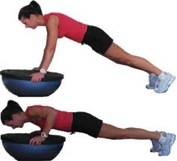
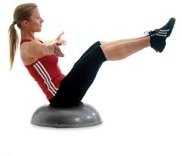
Learning to stabilize your core is the foundation for BOSU training. Your core is the epicenter of all your movements – 29 muscles that give you better balance, stability and agility no matter what your age. But the BOSU provides more than core stabilization. You can use the BOSU to work your arm, leg, abdominal, back and gluteal muscles. I’ve provided a few basic BOSU exercises below, but if you’re new to BOSU training, you’ll want to begin by simply standing on it to become familiar with its feel. Once that becomes easy, practice stepping off and on the BOSU from the side, then marching in place. Until you’re able to balance easily on your BOSU I recommend situating it next to something that you can grab or hold onto in case you lose your balance.
Now, try some of these exercises:

The TED Blog shares news about TED Talks and TED Conferences.
When you're moving, you're improving!
 COACH STACY'S HEALTHY U